Free, no sign-up. A starting point, not legal advice.
How it fits with your other documents
| Document | Signed | Holds |
|---|---|---|
| Proposal | Before the client decides | Why you, your approach, the price |
| Service agreement | Once per client | Payment terms, ownership, liability, ending it |
| Statement of work | Once per project | Deliverables, dates, fees for that project |
| Retainer agreement | For ongoing monthly work | Hours or output per month, fee, unused hours |
The split saves time. With a service agreement in place, the next project only needs a two-page statement of work instead of a new contract.
The 11 clauses, and what to decide in each
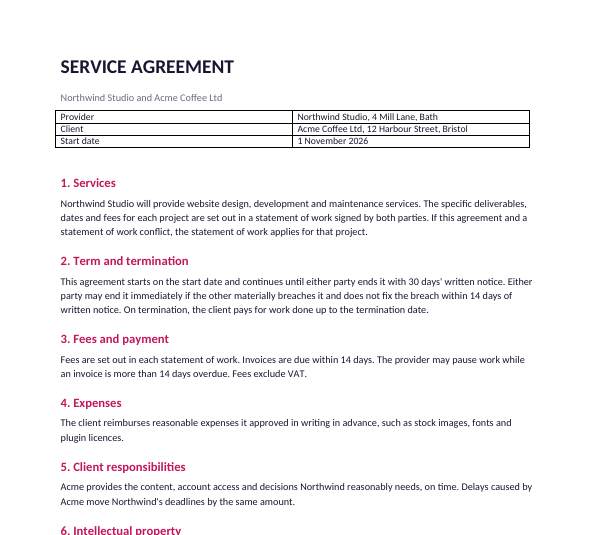
Each line in italics is from the filled-in example: a design studio and a coffee shop.
1. Services. Describe the type of work in general terms and say that each project gets its own statement of work. Also say which document wins if they disagree. "If this agreement and a statement of work conflict, the statement of work applies for that project."
2. Term and termination. How long it lasts and how either side can leave. Decide the notice period and what happens to unpaid work. "Either party may end it with 30 days' written notice... the client pays for work done up to the termination date."
3. Fees and payment. Payment terms that apply to every project: when invoices are due, and what you can do if they are late. Pausing work is the lever that actually gets invoices paid. "The provider may pause work while an invoice is more than 14 days overdue."
4. Expenses. Which costs the client pays on top, and that they approve them first.
5. Client responsibilities. The client's side of the deal. The key line is that their delays move your deadlines.
6. Intellectual property. When the work becomes theirs. Tying it to full payment protects you; keeping your own tools and code lets you reuse them; the portfolio line lets you show the work. "When Acme has paid in full for a deliverable, ownership of that deliverable transfers to Acme."
7. Confidentiality. Both sides keep each other's information private. Clients often ask for this first.
8. Warranties and limitation of liability. You promise reasonable skill and care, and cap what either side can claim. A cap at the fees paid in the last 12 months is common for small agencies.
9. Independent contractor. You are not their employee. This matters for tax and employment law in many countries.
10. Non-solicitation (optional). Neither side hires the other's staff for a period. Delete it if you work solo.
11. General. This is the whole agreement, changes must be in writing, and which country's law applies.
Clauses clients most often push back on
- Liability cap. Larger clients may ask for a higher cap or no cap. A common middle ground is a cap at a multiple of the fees, with exceptions for confidentiality breaches.
- Ownership on payment. Some clients want ownership as the work is created. If you agree, keep the right to stop work on late payment.
- Notice period. Clients prefer short notice, you prefer long. 30 days is a usual compromise.
Before you send it
- Every [square bracket] is replaced and the grey guidance lines are deleted.
- The governing law matches where you are based, or what you agreed.
- The payment terms match what your invoices say.
- You have a statement of work ready for the first project.
Send it as a link, and see when it is read
Contracts tend to sit unopened in an inbox. If you share it as a Snapy.host link, you get an email the moment the client opens it, on the free plan. With Pro you also see which pages they read, so you know whether they reached the liability clause before they come back with questions.