Free, no sign-up. The Word file opens in Microsoft Word, Google Docs and Pages.
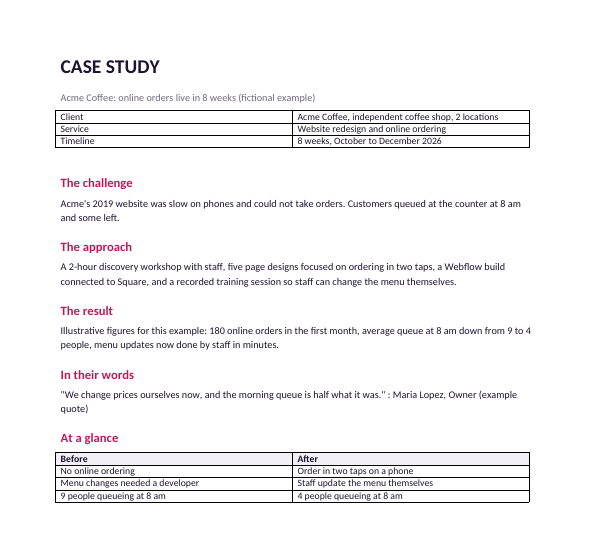
The four parts
- The challenge. The problem in the client's words, with a number if there is one. "Customers queued at the counter at 8 am and some left."
- The approach. What you did, in three to five steps, and why each step mattered.
- The result. Numbers first, and say how and when they were measured. Vague results ("improved engagement") make readers doubt the rest.
- In their words. A real quote from a named person, with their role.
The filled-in example follows a fictional coffee shop's website project. Its figures are illustrative and labelled that way; yours should be real and checked with the client.
A before-and-after table does most of the work
| Before | After |
|---|---|
| No online ordering | Order in two taps on a phone |
| Menu changes needed a developer | Staff update the menu themselves |
Many readers only look at this table. Make sure it holds your best result.
Getting the numbers and the quote
- Agree the measure at the start of the project, not after. "Orders per month" and "queue length at 8 am" are easy to count if you decide to count them.
- Ask for the quote with a specific question: "What changed for you since launch?" gets a better answer than "Could you write a testimonial?"
- Send the draft to the client before publishing. It is courteous, and they often add a better number.
Use it in your proposals
A case study works best when it's attached to a proposal for a similar client. Share it as a Snapy.host link and you get an email when it's opened, free. With Pro you can see whether the prospect read it.